In the realm of Japanese role-playing games, where linear narratives often reign supreme, a select few titles stand as towering exceptions—architectural marvels built not with single corridors of fate, but with sprawling, branching blueprints of possibility. Unlike many Western RPGs that wear their branching narratives as a badge of honor, these JRPGs weave choice into their very fabric with the subtle intricacy of a master watchmaker, creating experiences that demand—and richly reward—multiple journeys through their worlds. As we look back from 2026, these games remain timeless testaments to the art of interactive storytelling, their mechanics and narrative depth feeling as fresh and innovative as ever.
Tactics Ogre: Let Us Cling Together - The Precursor's Moral Compass
Widely regarded as the precursor to Final Fantasy Tactics, this turn-based strategy masterpiece shares a dark, politically charged DNA with its successor. Yet, it carves its own legacy by placing the power of narrative influence directly into the player's hands. Here, the story is not a river with a single current, but a delta where key decisions—often moral choices that dwell in gray areas—determine which channels the plot will flow through. Major characters can meet untimely ends based on seemingly innocuous dialogue selections, their fates as fragile as a spider's web in a storm. The game teaches players that words are not just exposition; they are seeds, and one never knows which might grow into a narrative tree that shadows the entire journey.
Star Ocean: The Second Story - Sprite-Based Depth
While its sprite-based visuals might have seemed primitive next to the polygonal pioneers of the original PlayStation era, Star Ocean: The Second Story was an engine of narrative complexity humming beneath a classic hood. Its branching paths were not mere cosmetic changes. An early, fundamental choice—which of two protagonists to guide—unlocks entirely different perspectives on the unfolding cosmic drama. This decision is like choosing which lens to view a kaleidoscope through; the same fragments of light and color rearrange into profoundly different patterns. Furthermore, party recruitment becomes a puzzle box that cannot be solved in one sitting, and story choices cascade toward multiple endings, making replayability not a suggestion, but a core tenet of experiencing its full universe.
Front Mission 3 - The Dual-Scenario Mech Epic
Front Mission 3 took a bold, architectural approach to its narrative, constructing what felt like two distinct games from a shared foundation. An early choice bifurcates the story into two drastically different scenarios—stories that run parallel yet separate, like twin railways departing from the same station toward opposite horizons. While some mission overlap exists, the context, character motivations, and overarching plot diverge so significantly that playing both paths feels like uncovering two halves of a grand geopolitical mech thriller. For its time, offering such a substantial, choice-driven narrative in an RPG was as rare and impactful as finding a dual-core processor in a world of single-core chips.
Riviera: The Promised Land - Where JRPG Meets Dating Sim
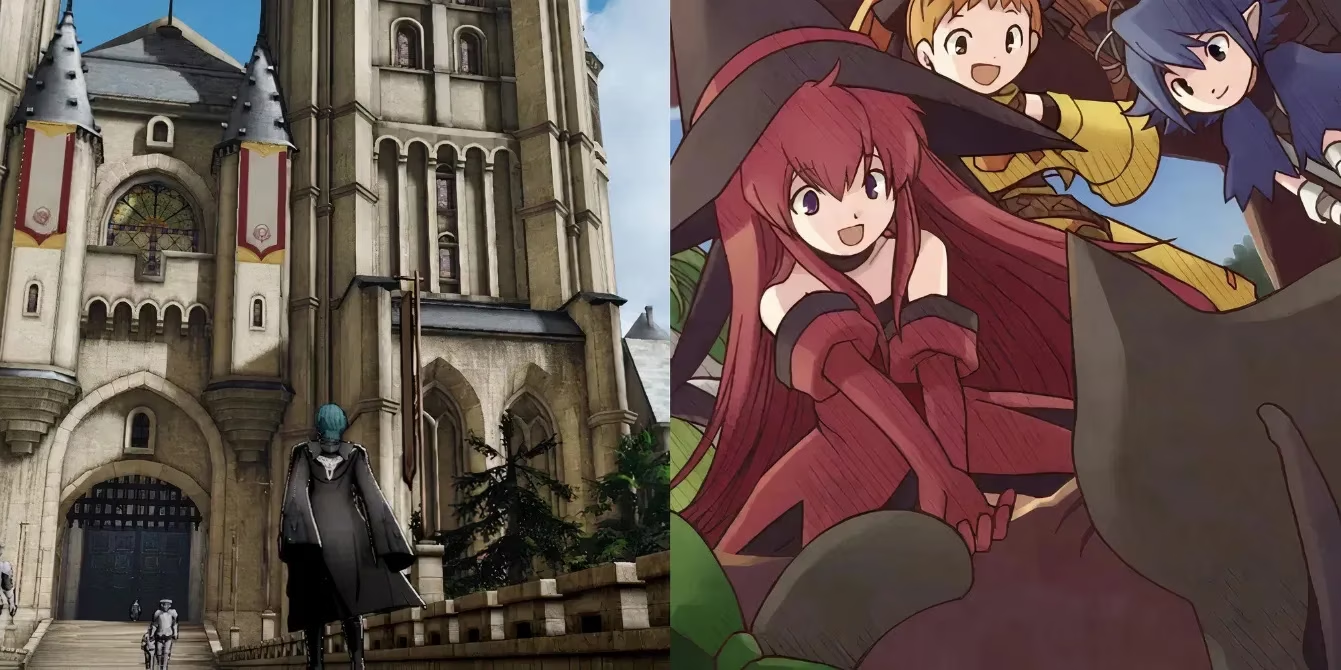
This cult classic is a fascinating chimera, blending traditional JRPG adventure with dating-sim mechanics. Its unique structure—even limiting free exploration—forces focus onto its heart: relationships. Every conversation with Ein's party members is a thread pulled on the tapestry of the ending. Showing favor, making dialogue choices, and navigating interpersonal dynamics doesn't just change a scene; it alters the story's destination. Riviera's journey from a Japan-exclusive WonderSwan Color title to its modern availability on platforms like Nintendo Switch and PC is a testament to the enduring appeal of its innovative, choice-driven romance and adventure.
Triangle Strategy & The Scales of Conviction
A direct spiritual successor to the tactical greats, Triangle Strategy elevates decision-making to a ceremonial, communal act. Through the "Scales of Conviction" mechanic, the game pauses not for a solitary choice, but for a democratic debate among your party members. This transforms narrative branching from a private calculation into a public deliberation, where persuasion and conviction matter. The game then clearly signals when the consequences of a choice have fully unfolded, providing a satisfying clarity to its branching structure. It treats its narrative paths not as hidden secrets, but as earned outcomes of collective philosophy.
Fire Emblem: Three Houses - A Trifurcated Saga
True to its name, Fire Emblem: Three Houses presents players with a monumental choice after its prologue: which of three noble houses to lead. The first half of the game, shared among the paths, is like a communal greenhouse where relationships and characters grow. The second half, however, sees the narrative explode into three wholly unique wars, each with its own perspective, allies, and tragedies. The branching here is not subtle; it is continental drift. Combined with deep class customization and unit progression, replaying each path feels like living through three different historical accounts of the same turbulent era, each colored by the ideology you chose to embody.
| Game | Key Branching Mechanic | Replay Incentive |
|---|---|---|
| Tactics Ogre | Moral & dialogue choices altering story & character survival | See the political drama unfold from different ethical standpoints |
| Star Ocean 2 | Protagonist choice & party member recruitment locks | Experience two sides of the story & recruit all possible allies |
| Front Mission 3 | Early choice between two distinct scenario paths | Play two different mech-piloting narratives in the same conflict |
| Riviera | Relationship-building & dialogue choices affecting ending | Achieve different romantic and narrative conclusions |
| Triangle Strategy | Democratic "Scales of Conviction" votes after party debates | Witness how different convictions change a kingdom's fate |
| Fire Emblem: 3H | Choosing one of three houses, leading to vastly different wars | Lead three different armies in a continent-spanning conflict |
These games prove that the JRPG genre, often associated with predetermined destinies, can host some of gaming's most compelling branching narratives. They understand that true replay value comes not from grinding, but from revelation—from seeing how a different choice can make a familiar world feel as new and strange as a forgotten continent rising from the sea. In 2026, they remain essential play for any fan of stories where the player's will is the author's pen.