As I sit here in 2026, reflecting on my gaming journey over the past decade, I realize that some of my most memorable adventures didn't take place in sprawling fantasy kingdoms or distant galaxies, but right within the hallways of fictional schools. There's something uniquely compelling about JRPGs that use academic settings—they take the familiar rhythm of classes, friendships, and teenage drama and inject it with supernatural mysteries, psychological depth, and world-saving stakes. For me, these games aren't just about escaping reality; they're about finding the extraordinary hidden within the ordinary, discovering that the person sitting next to you in class might be battling inner demons—sometimes quite literally.
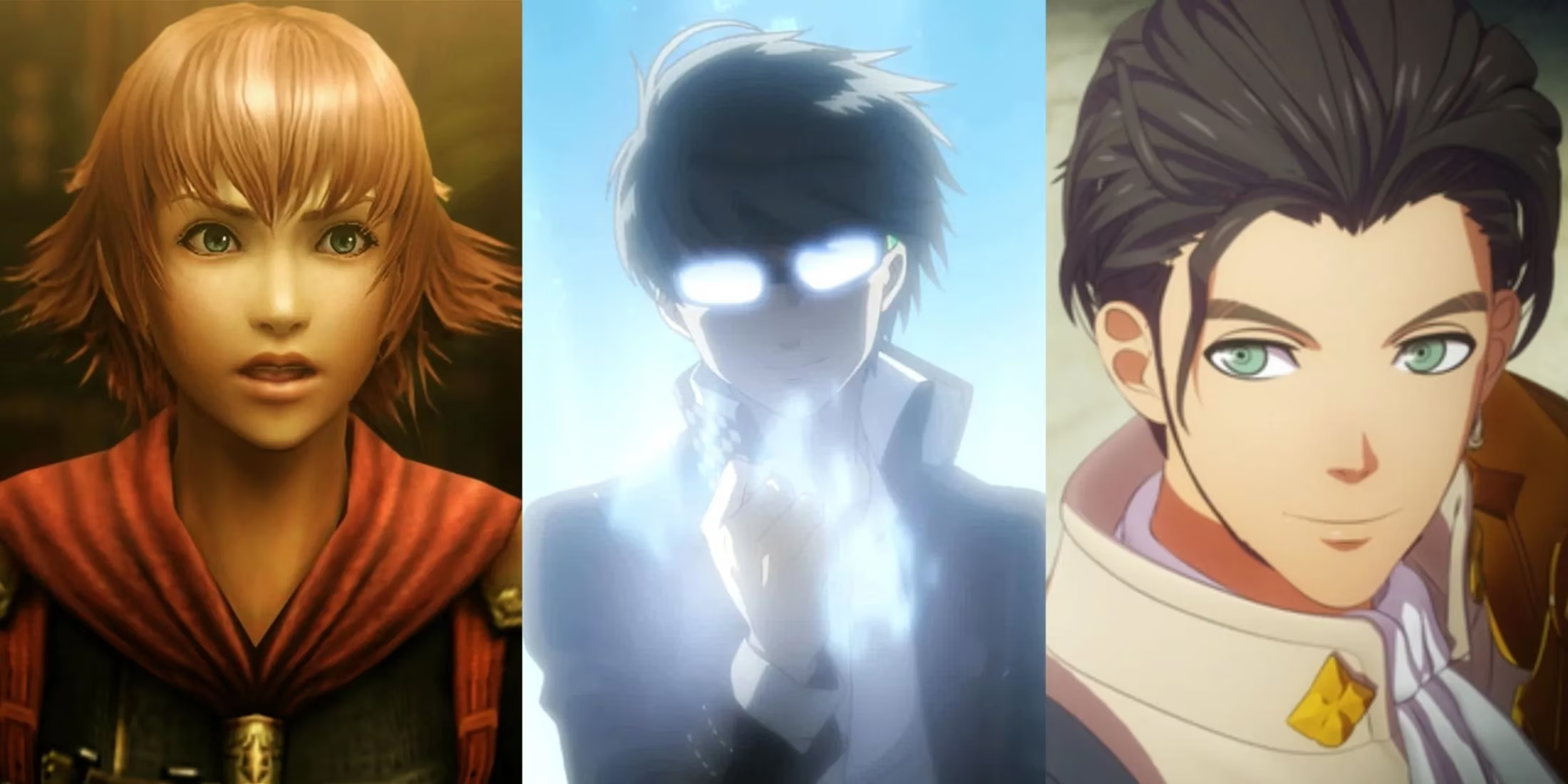
Let me take you through my personal hall of fame, starting with Monark—a real hidden gem I stumbled upon back in 2022. I remember booting it up on my PlayStation 5, not expecting much, but wow, was I in for a ride! The Shin Mikado Academy felt immediately unsettling, like there was this palpable tension in the air. The game's premise—students being driven mad by mysterious energy—wasn't just background noise; it permeated every interaction. What really got me was how it balanced reality with the "Otherworld," that shadowy dimension where daemons lurked and pacts granted supernatural powers. The tactical combat system with its madness and awakening gauges? Chef's kiss! But beyond the mechanics, it was the exploration of the seven deadly sins through introspective dilemmas that stuck with me. It made me question my own choices in ways few games have.
Then there's The Caligula Effect: Overdose—talk about a mind-bender! This one had me questioning reality itself. The virtual world of Mobius presented as this perfect school utopia, but as I dug deeper, I uncovered layer upon layer of psychological complexity. The gameplay mechanic of anticipating enemy actions before they happened made every battle feel like a chess match. But the real magic? Building bonds with characters, each hiding their own traumas beneath their digital facades. This game wasn't just about escaping a false reality; it was about confronting why we want to escape in the first place. It hit me right in the feels, as the kids used to say.
Blue Reflection was a different vibe altogether—more poetic, more introspective. Playing as Hinako Shirai, the injured ballerina finding solace in school life, felt incredibly personal. The way it blended mundane school routines with dreamlike journeys into a psychic realm was nothing short of beautiful. Each character's abilities reflected their internal struggles, making every power-up feel like emotional progress. I remember thinking, "This isn't just leveling up stats; this is watching someone heal." The emphasis on overcoming insecurities and strengthening bonds through both everyday conversations and supernatural battles created an experience that stayed with me long after the credits rolled.
Now, let me tell you about Tokyo Xanadu eX+—this one felt like coming home in the best way possible. As a fan of Nihon Falcom's Legend of Heroes series, I recognized their signature touch immediately, but with a modern, action-oriented twist. Controlling Kou Tokisaka, an ordinary student drawn into extraordinary circumstances, felt incredibly relatable. The seamless transition between attending classes and exploring the Eclipse—that mysterious realm filled with dangers—was executed brilliantly. The combat leaned more toward real-time action than traditional turn-based, which kept me on my toes. But what really sold me was how the school setting wasn't just a backdrop; it was the anchor that made the supernatural elements feel more impactful.
| Game | Release Year | Key School Setting Feature |
|---|---|---|
| Monark | 2022 | Shin Mikado Academy with reality-bending mysteries |
| The Caligula Effect: Overdose | 2018 (original) | Virtual school world hiding psychological truths |
| Blue Reflection | 2017 | Everyday school life blended with psychic realms |
| Tokyo Xanadu eX+ | 2016 | Modern Tokyo school with parallel supernatural world |
| Final Fantasy Type-0 | 2011 | Military academy during wartime |
Speaking of military academies, Final Fantasy Type-0 took the school concept to a whole new level of intensity. Class Zero wasn't just studying for exams; they were being mobilized to protect their nation from invasion. The balance between academic responsibilities and large-scale warfare created this constant tension that drove the narrative forward. Themes of camaraderie and sacrifice hit particularly hard, especially when you remember these were essentially teenagers being thrust into horrors they shouldn't have to face. And those optional lectures that boosted character attributes? Genius! It made attending class feel meaningful beyond just story progression.
I have to give a special shoutout to Kowloon High-School Chronicle, a title that doesn't get nearly enough love. Playing as a treasure hunter infiltrating Kamiyoshi Academy felt like being in my own anime adventure. The episodic structure—daytime visual novel segments followed by nighttime dungeon exploration—created this perfect rhythm. But what really stood out was the relationship mechanic where emotional inputs during dialogues actually influenced story development. It reminded me of Persona (which we'll get to!), but with its own unique flavor blending Egyptian and Japanese mythologies. The mix of RPG, adventure, and simulation elements in a school setting? Absolutely my jam!
The Legend of Heroes: Trails of Cold Steel series deserves its own paragraph—or maybe its own book! Thors Military Academy wasn't just a setting; it was a character in itself, reflecting the social divisions of the Erebonian Empire. Following Rean Schwarzer and Class VII as they challenged injustices while navigating political tensions felt incredibly immersive. And when Rean returned as an instructor in the third installment? Full-circle moment! The academy served as this constant anchor throughout the series, connecting events and characters in ways that made the world feel alive and interconnected.
In more recent years, even mainstream franchises have embraced the school setting. Pokemon Scarlet and Violet placing us as transfer students at Naranja or Uva Academy felt like a natural evolution. The treasure hunt framing device encouraged exploration in a way that felt organic to both the school setting and the Pokemon journey. Attending classes that actually taught useful information about the game's mechanics? What a concept! While much of the narrative unfolded beyond school grounds, the academy remained this constant touchstone—a home base in the truest sense.
But if we're talking about masterclasses in blending school life with epic narratives, Fire Emblem: Three Houses absolutely nailed it. Taking on the role of a professor at the Officers Academy added this layer of responsibility that changed how I approached relationships with characters. Guiding students from three distinct houses toward their development, knowing that my choices would dramatically alter the narrative's direction? Talk about pressure! The time-management elements made every decision feel consequential, and seeing how relationships forged during school days impacted the latter half of the story was storytelling at its finest.
And then, of course, there's the elephant in the room—or should I say, the velvet room? Persona 4 Golden remains, in my humble opinion, the gold standard for school-set JRPGs. What sets it apart isn't just the supernatural murder mystery or the dungeon crawling; it's how every aspect of school life matters. Social links with all your companions (not just potential romantic interests), performing well on exams actually affecting your relationships, the sense that you're living a double life—it all comes together to create this incredibly immersive experience. The school setting isn't just where the story happens; it's why the story matters.
Looking back on these experiences, I realize what makes school settings in JRPGs so effective:
-
Relatability: We've all been to school, so we understand the rhythms and relationships
-
Structure: The academic calendar provides natural pacing and progression
-
Character Development: School is where people grow and change dramatically
-
Stakes Amplification: When supernatural elements invade familiar spaces, the contrast heightens tension
-
Social Dynamics: Hierarchies, cliques, and friendships create ready-made conflict and connection
In 2026, as gaming continues to evolve with new technologies and storytelling techniques, I find myself returning to these school-set JRPGs like old friends. They remind me that the most epic adventures often begin in the most ordinary places—that saving the world doesn't always require a legendary hero, sometimes it just requires showing up to class, making connections, and being brave enough to face whatever mysteries hide in the shadows of the hallway. Whether it's battling daemons between periods or solving murders after school, these games prove that growing up—with all its challenges and triumphs—is the greatest adventure of all. And honestly? I wouldn't have it any other way. These virtual hallways have taught me more about friendship, courage, and self-discovery than any real classroom ever could. They're not just games; they're coming-of-age stories with turn-based combat, and I'm here for every magical, memorable moment.
Data referenced from HowLongToBeat helps contextualize why school-set JRPGs like Persona 4 Golden, Trails of Cold Steel, and Tokyo Xanadu eX+ feel so lived-in: their longer “Main + Extras” playtimes often align with calendar-driven structures, where classes, bonding events, and side activities create a steady cadence between daily-life scenes and high-stakes dungeon runs.