In the ever-evolving world of JRPGs, where epic stories and turn-based battles have reigned supreme for decades, one feature continues to capture the hearts of strategic masterminds and meticulous planners alike: party customization. 🤯 It’s the digital equivalent of building a fantasy sports team, but with more magic spells and fewer salary caps. While many modern games dazzle with flashy combat or cinematic narratives, the true joy for many lies in the granular control of shaping a ragtag group of heroes into a finely-tuned, unstoppable force. This isn't just about picking the strongest sword; it's about crafting a unique identity for your party, where every stat point, job change, and skill selection tells the story of your adventure. Let's dive into the games that turn you from a mere player into a legendary party architect.
🛡️ Final Fantasy Tactics: Where Chess Meets Character Sheets
Picture this: a kingdom torn by civil war, where political intrigue is as thick as the armor on a Knight. Into this chaos steps Final Fantasy Tactics, a game that treats party customization not as a side activity, but as the main event. Set in the rich world of Ivalice, this title is a masterclass in strategic depth. Players aren't just assigning roles; they're mixing and matching abilities from a dizzying array of jobs—from the straightforward power of a Knight to the elegant lethality of a Samurai. The real magic happens in the combinations. Want a Monk who can also cast White Magic? Go for it. A Thief with the counterattacks of a Ninja? The game says, "Why not?" Balancing this intricate job progression with the unfolding story is a deeply rewarding puzzle, making every battle feel like a personal triumph of your design. It’s less about following a preset path and more about painting your own masterpiece with the broad brushstrokes of class systems.
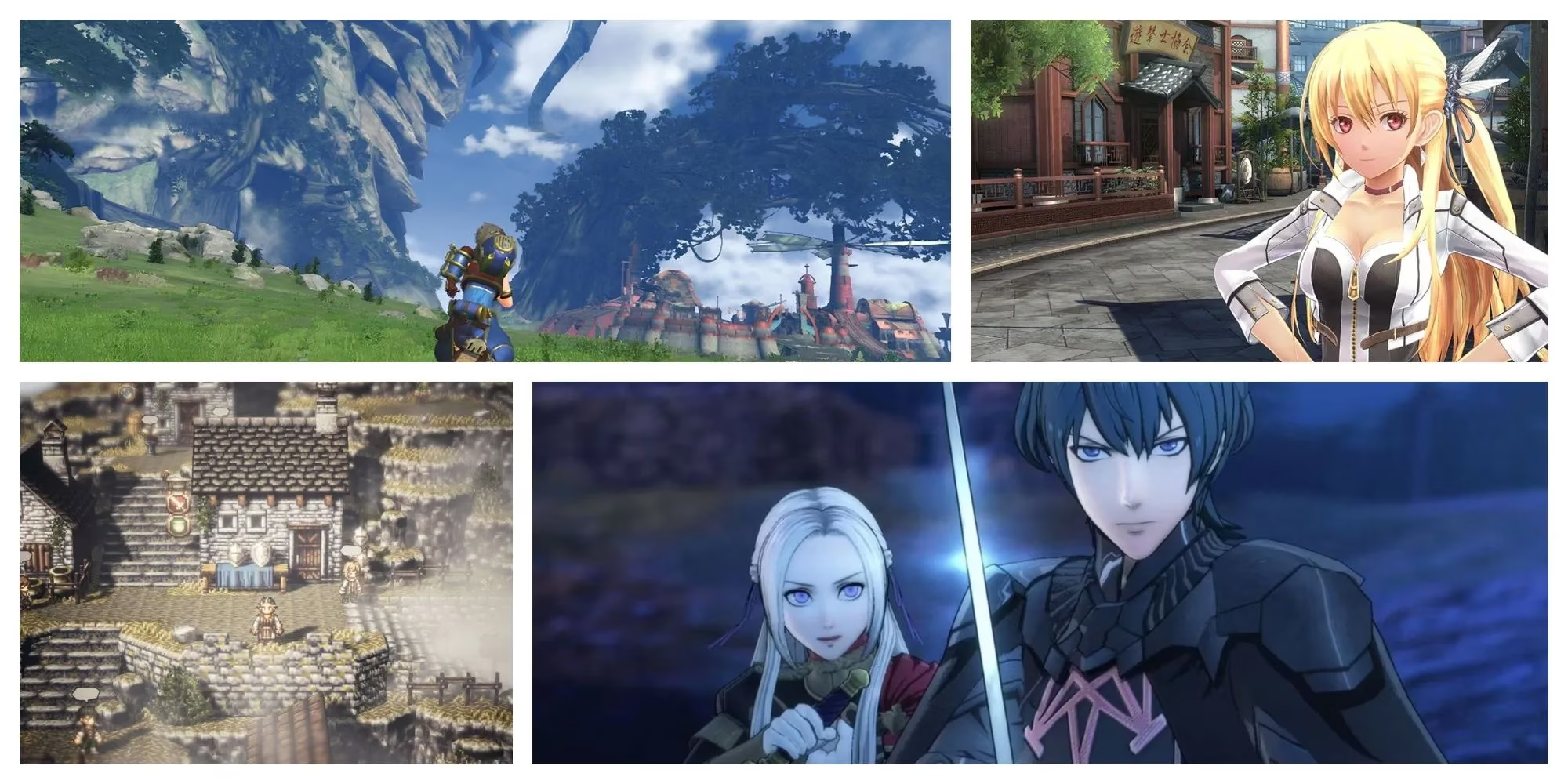
🏰 Fire Emblem: Three Houses: Professor, Build Your Army
Step into the polished shoes of Byleth, a mercenary-turned-professor at the prestigious Garreg Mach Monastery. Fire Emblem: Three Houses isn't just a game; it's a teaching simulator where your lesson plan involves swordplay, sorcery, and shaping the future of a continent. The core customization here is genius: you choose one of three noble houses to lead, and that choice ripples through the entire narrative, offering different plots, allies, and political dramas. But the real power lies in the classroom. You have full control over how your students evolve. That shy archer in the Black Eagles? You can mold her into a deadly assassin. The boisterous brawler in the Blue Lions? Perhaps he'd excel as an armored knight. The in-depth class system lets you shift roles based on stats and your strategic vision. With enough effort, you can even poach students from rival houses, creating a truly unique dream team. It’s a compelling blend of life simulation and tactical RPG, where the bonds you forge are as important as the skills you teach.
| Customization Aspect | Impact on Gameplay |
|---|---|
| House Selection | Dictates main storyline, allies, and key conflicts. |
| Class Training | Allows reshaping of character roles (e.g., Mage to Warrior). |
| Skill Focus | Determines weapon proficiency and special abilities in battle. |
| Recruitment | Enables creating a cross-house "all-star" party. |
🧭 Octopath Traveler: Eight Stories, Endless Combinations
Octopath Traveler asks a beautiful question: what if a party wasn't defined by a single quest, but by eight intertwined destinies? Set in the enchanting land of Orsterra, the game follows eight distinct characters, each with a full, personal narrative. The customization shines in its elegant simplicity. Each traveler has a primary job (like Scholar or Merchant), but you can assign a secondary job to anyone. This opens a treasure trove of combinations. Imagine a Hunter who can also wield the powerful elemental magic of a Scholar, or an Apothecary with the debuffing skills of a Thief. While the system isn't the most complex on this list, it perfectly complements the game's "Boost" battle mechanic. By strategically mixing jobs, you can set up devastating multi-hit attacks that turn the tide of battle. It’s proof that deep customization doesn't always need a thousand menus—sometimes, one brilliant secondary choice is all it takes.
⚙️ The Legend of Heroes: Trails of Cold Steel 3: The Orbment of Power
Welcome to the Erebonian Empire, a land simmering with political unrest and mystical technology. In Trails of Cold Steel 3, you return as Rean Schwarzer, now an instructor tasked with mentoring a new Class VII. The party customization here is nothing short of spectacular, thanks to the brilliant Orbment System. Think of it as a high-tech puzzle board for your characters' souls. By slotting different "Quartz" into a character's Orbment, you directly customize their stats, unlock new spells (called Arts), and passive skills. It's a deeply tactile and rewarding system that makes every character a blank slate for your strategic experiments. Combine this with a nuanced class system (Special Ops, Combat Tactics, Military Finance), and you have a game where no two parties are ever the same. You're not just preparing students for exams; you're engineering warriors for a coming war.
☁️ Xenoblade Chronicles 2: Bond with Your Blade
In the world of Alrest, humanity lives on the backs of colossal Titans, drifting in an endless sea of clouds. Xenoblade Chronicles 2 offers a customization system as unique and vast as its setting. Here, your power comes from bonding with Blades—sentient weapon beings. As the driver Rex, your primary Blade is the fiery Pyra, but the system explodes from there. Each Blade you resonate with grants different weapons, elemental affinities, and field skills. The customization is a thrilling loop of discovery: find a rare Blade, unlock its skill tree, and integrate its powers into your battle strategy. With hundreds of possible Blade and Driver combinations, the game truly lives up to the phrase "the sky's the limit." It’s a system that turns every encounter into a potential for growth, where the bond between driver and Blade is the ultimate customizable stat.
🔮 Why Customization Still Reigns Supreme in 2026
As we look at the JRPG landscape in 2026, the hunger for deep party customization is stronger than ever. In an age of hand-held narratives, these games offer something precious: agency. They transform players from spectators into creators. The joy isn't just in seeing a story unfold, but in knowing that your unique party composition—the result of a hundred small decisions—is the engine driving that story forward. Whether it's the tactical chess of Final Fantasy Tactics, the professorial mentorship of Three Houses, or the symbiotic bonds of Xenoblade Chronicles 2, these games understand that the most powerful weapon in any JRPG isn't a legendary sword. It's a well-crafted team, bearing the unmistakable signature of the player who built it. So, go forth, tinker with those job systems, slot in those Quartz, and bond with those Blades. Your perfect party awaits. 🎮✨